D.7 Solaris
These results come
from
Solaris Version 8 for Intel (released February 2002). Solaris 9 was
available when I started these tests, but Sun no longer makes it
freely available. I tweaked the kernel by adding these lines to
/etc/system:
set rlim_fd_max = 8192

set msgsys:msginfo_msgmax=8192

set msgsys:msginfo_msgmnb=8192

set msgsys:msginfo_msgmni=40

set msgsys:msginfo_msgssz=64

set msgsys:msginfo_msgtql=2048

set shmsys:shminfo_shmmax=2097152

set shmsys:shminfo_shmmni=32

set shmsys:shminfo_shmseg=16
Table D-5 and Figure D-5
summarize the Solaris results. This is the only other operating
system, in addition to Linux, in which the aufs
storage scheme works well. Interestingly, both
aufs and diskd have about
the same performance on Solaris, although the actual numbers are much
lower than on Linux.
Table D-5. Solaris benchmarking results|
|
diskd(1)
|
UFS
|
noatime
|
56.3
|
1.53
|
55.7
| |
aufs(1)
|
UFS
|
noatime
|
53.6
|
1.49
|
56.6
| |
diskd(2)
|
UFS
| |
37.9
|
1.53
|
55.5
| |
aufs(2)
|
UFS
| |
37.4
|
1.49
|
56.4
| |
coss
| | |
32.4
|
1.47
|
54.6
| |
ufs(1)
|
UFS
|
noatime
|
24.0
|
1.53
|
55.6
| |
ufs(2)
|
UFS
| |
19.0
|
1.50
|
56.3
|
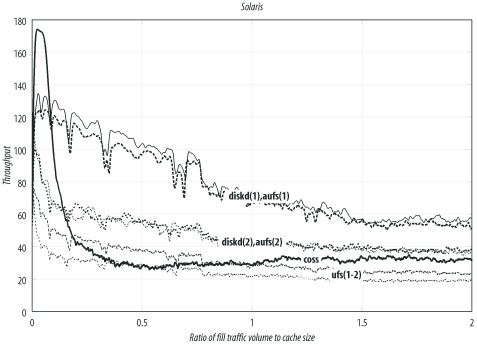
Solaris also supports coss, but at nowhere near
the rates for Linux and FreeBSD. For some unknown reason,
coss on Solaris is limited to 32 transactions
per second.
| 
